How to Pack Foam Sleeping Pad Inside Backpack: No External Straps
Learn how to pack foam sleeping pad inside backpack, shape it as a cylinder, and avoid external straps while keeping gear balanced and pad protected.
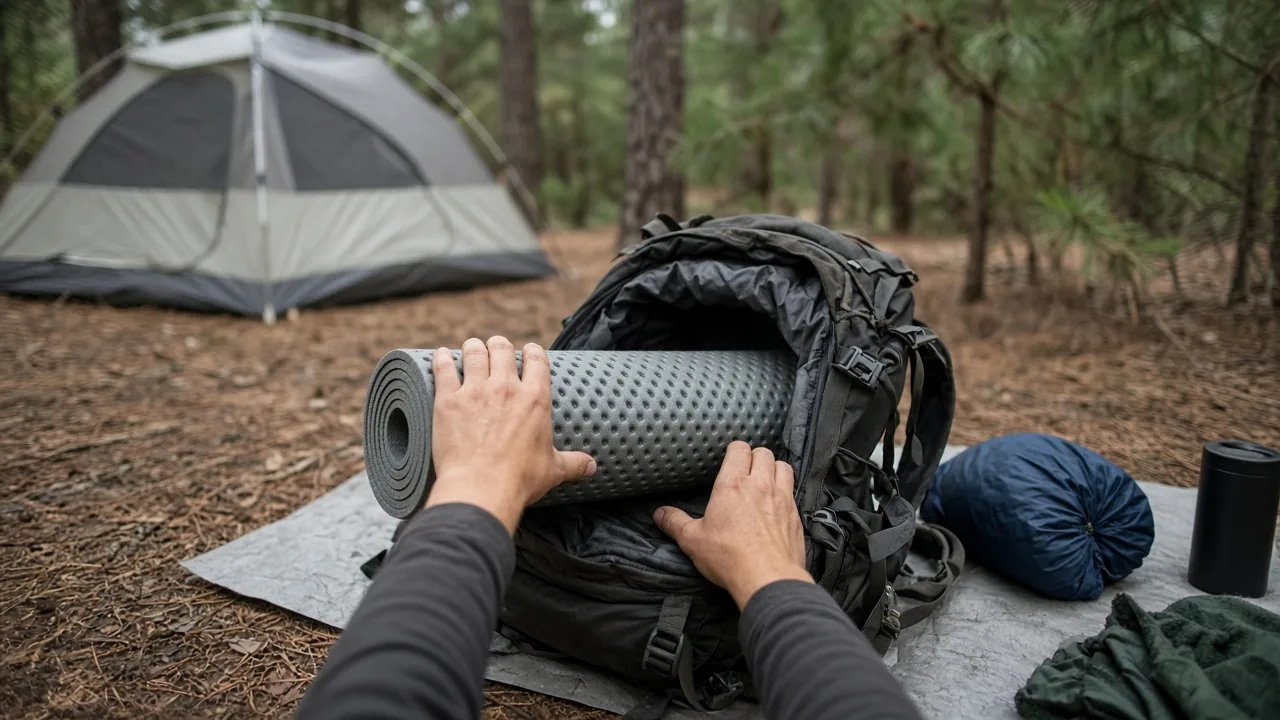
A foam sleeping pad can fit inside a backpack if you shape it as a cylinder, use it as a divider, and pack soft gear through the center. Learning how to pack foam sleeping pad inside backpack without external straps reduces snagging, protects the pad from abrasion, and keeps the load closer to your back when pack volume allows. The method below works best when you match pad height to the pack body and accept some lost interior space.
Why Should You Pack a Foam Sleeping Pad Inside Your Backpack?
External straps catch on brush, make the pack awkward through narrow trails, and expose the pad to scrapes. A closed-cell foam pad is tough, but the cut edges and outer surface can still abrade over time. When pack volume allows, carrying the pad inside can reduce that wear and keep the pack profile narrower.
Foam Pads Are Bulky but Reliable
Closed-cell foam pads like the Therm-a-Rest Z-Lite are nearly puncture-proof and low-cost, but they do not compress small. A typical foam pad is 0.4 to 0.8 inches thick, with an R-value around 2 to 3, and weighs roughly 14 to 23 ounces. That modest weight is appealing for backpacking, but the fixed volume creates the packing problem.
Inside Pack vs Outside Straps: What You Trade
Internal carry can reduce snagging and pad damage, but it may eat pack space. The method below uses the pad as a flexible cylinder so it fills gaps instead of wasting room. You trade some interior capacity for a cleaner pack profile and less chance of tearing the pad on a branch or rock.
How to Pack Foam Sleeping Pad Inside Backpack: Step-by-Step Method
Start by choosing a pad no longer than your pack body. If it is too tall, trim a few sections. Then fold or roll the pad into a cylinder, place it inside the pack, and load gear around and through it so the pad expands into empty spaces. Follow the sequence below.
Match Pad Length to Pack Height First
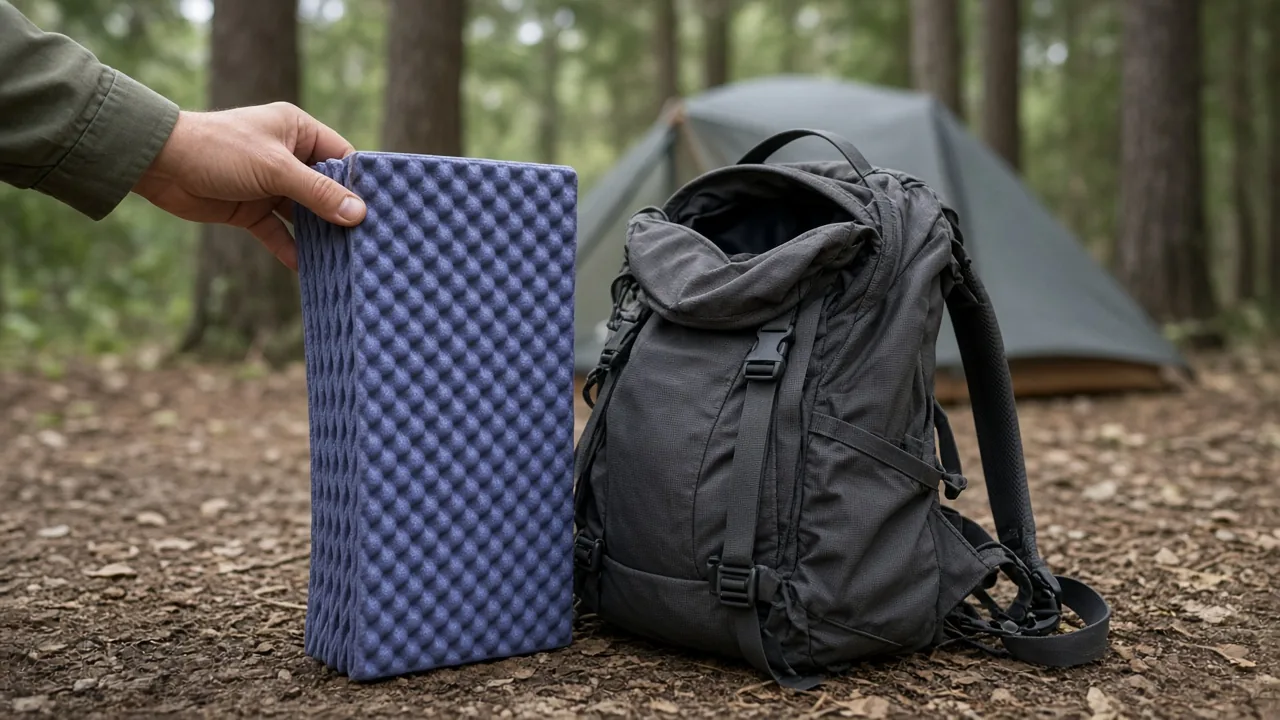
If the pad is too tall, trim a few panels until it fits. Keep your head and core on the pad rather than your full height. The head end can be shorter because your head spends much of the night on a pillow, not directly on the sleeping pad. For most three-season trips, protecting your shoulders, torso, and hips matters more than extending the pad under your entire body.
Create a Cylinder and Pack Gear Inside the Center
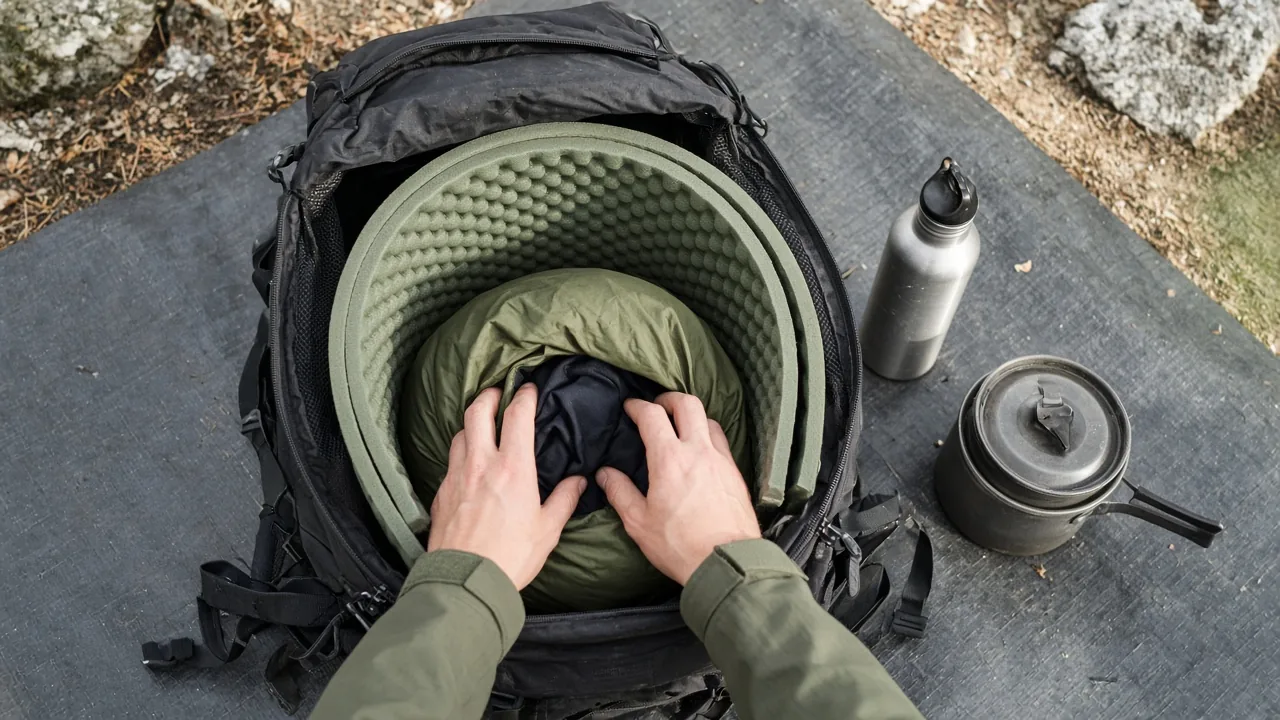
Shape the pad as an open tube or C-shape inside the pack. Load clothes, a stuff sack, or other soft gear in the middle so the pad uses space efficiently. The foam is flexible and will gradually expand as you add more gear, filling gaps around water bottles, cookware, and other hard items. This prevents the pad from behaving like a rigid panel that wastes the center of the pack.
Follow Pack Weight and Safety Order
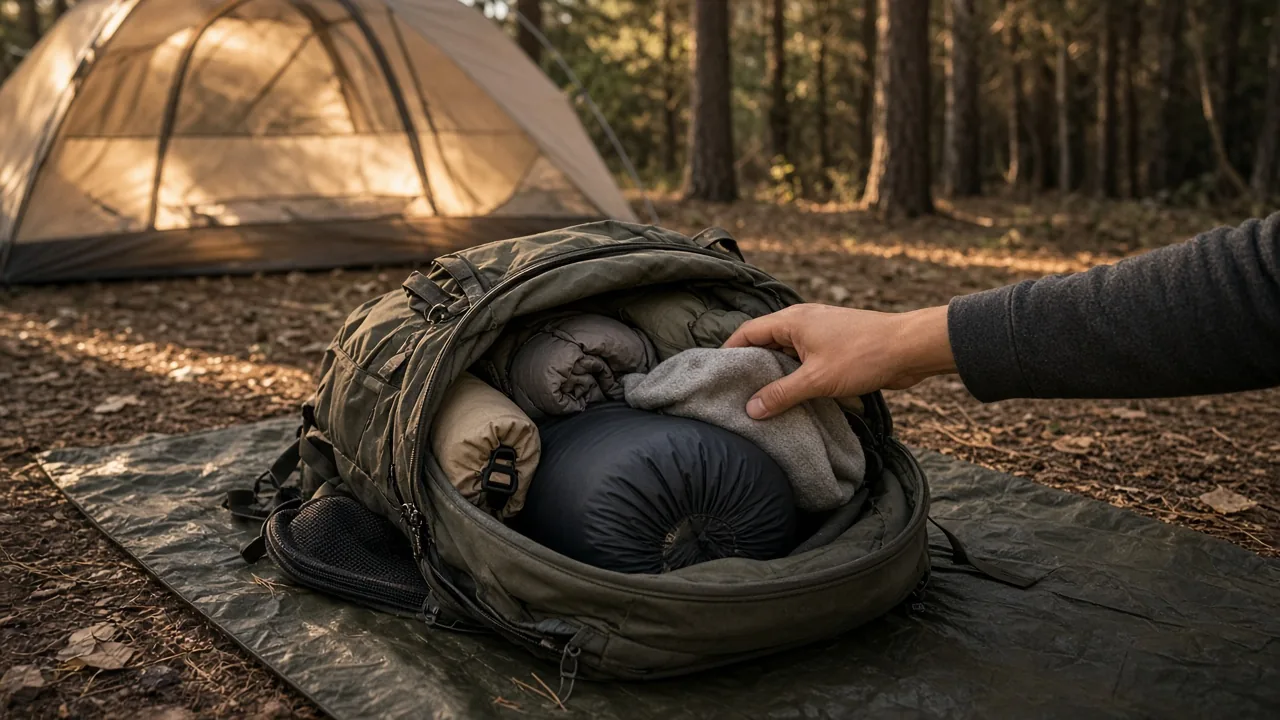
Place heavy items close to your back and lower in the pack, lighter items outward. Never use a stove or heater inside your tent. Also never pack a running or lit stove or heater inside a backpack. Shut down the stove, let it cool, and seal fuel according to the manufacturer's instructions before it goes near your sleep system. Before the trip, check fire restrictions and campsite rules for the area.
Can You Cut a Foam Sleeping Pad Shorter to Fit Inside a Backpack?
Many backpackers trim closed-cell foam pads to torso length to save weight and pack volume. The key is keeping insulating material under your shoulders, torso, and hips. A shorter pad can fit inside more packs without forcing you to overstuff the main compartment or use outside straps.
Where to Cut Without Losing Needed Warmth
Cut from the head end first. Your head spends most of the night on a pillow, so removing a few panels from that end usually hurts warmth less than cutting the core area. Leave enough length to cover from your shoulders to your hips, including the area under your legs if you sleep on your back and tend to slide down during the night.
Who Should Avoid Cutting a Foam Pad
Taller side sleepers or cold-weather campers may need full length. Any exposed body part on snow or frozen ground can chill quickly. If you often roll onto your side or stomach, a torso-length pad may leave your knees or feet off the pad. In those cases, keep the full pad or pair it with a short inflatable pad for the lower body.
Will a Foam Sleeping Pad With R-Value 2 or 3 Be Warm Enough?
A typical foam pad with R-value around 2 to 3 suits three-season use. It is not enough by itself for snow or very cold ground because more heat moves into the earth. For summer and most spring or fall nights, it can work, but the ground temperature matters more than the air temperature.
R-Value Ranges for Car Camping and Backpacking
Use R-value 1–2 for warm summer trips, 2–4 for three-season nights, and 4–6 or higher for cold weather. A high-R pad still works in summer because sleep pads don't overheat like bags. For car camping, you can carry a heavier, higher-R pad without worrying about pack volume. For backpacking, weight and packed size push many people toward R-value 2–3 foam or a mid-range inflatable pad.
Winter Use: Pair Foam With an Insulated Inflatable Pad
In snow, stack a foam pad under an inflatable pad to add puncture protection and insulation. The foam acts as a barrier against frozen ground, while the inflatable pad provides most of the R-value and cushion. Another option is to choose a high-R inflatable such as a pad in the R-value 6+ range. For example, the NEMO Tensor Extreme has an R-value of 8.5 and weighs about 1 pound 1 ounce. It is better suited to winter use than a foam pad alone, but it still carries the puncture risk of an inflatable design.
Is a Foam Sleeping Pad Comfortable Enough for Side Sleepers?
Side sleepers often find 1 to 2 centimeters of closed-cell foam less cushioned than an inflatable pad. The source of the pain may not be the pad alone. A long day of hiking can leave hips tight, and that tightness can make side sleeping feel worse than it would at home.
Foam vs Inflatable Comfort Trade-Offs
Foam weighs less and resists punctures, while inflatable pads offer more thickness and contouring. Heavier campers may feel the ground through thin foam, especially under the hips and shoulders. If comfort is your top priority and you backpack only on smooth or moderate terrain, an inflatable pad may be the better choice. If you want a pad that can take abuse and double as a sit pad, foam wins.
Hip Stretch That May Reduce Side-Sleep Pain
A post-hike hip stretch like pigeon pose can reduce side-sleep pressure in some people. The idea is to open the hip flexors and glutes before bed, which may reduce the urge to curl up or put extra pressure on one hip. This does not fully replace a thicker pad for everyone. If you still wake up sore after several nights, a thicker inflatable pad or a foam-plus-inflatable setup may be worth testing.
How Long Does a Foam Sleeping Pad Last Once You Pack It Inside Your Backpack?
A closed-cell foam pad can last roughly 100 nights or 1,000 miles before it visibly flattens. It usually fails gradually rather than splitting like an inflatable pad. You may not notice the loss of cushion because the change happens over many nights, but it becomes obvious when you compare an old pad with a new one.
Signs It Is Time to Replace the Pad
Look for crushed panels, reduced cushioning, or a loss of loft. Press your thumb into the high-use areas under your hips and shoulders. If the foam does not spring back the way it used to, it may be time for a new pad. Because basic foam pads are inexpensive, replacement is often simpler than repair.
Packing and Storage Habits That Slow Wear
Keep the pad clean and dry. Avoid storing it tightly compressed or kinked for long periods. Before you pack, check the inside of your backpack for sharp objects that could abrade the pad over time. A small tear in a foam pad is not usually fatal, but repeated rubbing against a buckle or stove edge can wear down the surface.
Foam Sleeping Pad vs Inflatable Pad: Which Should Go Inside Your Backpack?
For inside-pack carry, a foam pad is more forgiving when bent but takes more fixed volume. An inflatable pad packs smaller but is more vulnerable to punctures. The right choice depends on your trip length, nighttime lows, terrain, and how much discomfort you are willing to accept.
Compare Weight, R-Value, Thickness, and Best Use
| Pad type | Approx. weight | R-value | Approx. thickness | Best use |
|---|---|---|---|---|
| Z-Lite-style closed-cell foam | 14–23 oz | 2–3 | 0.4–0.8 in | Three-season backpacking, rough terrain, budget-friendly, sit pad |
| Klymit Static V2 inflatable | 14.5 oz | 1.3 | Not listed in spec used here | Warm-weather backpacking when small packed size matters |
| Big Agnes Divide inflatable | 1 lb 4 oz | 1.4 | 2.0 in | Warm three-season car camping or shorter backpacking trips |
| NEMO Tensor Extreme insulated inflatable | 1 lb 1 oz | 8.5 | Not listed in spec used here | Cold-weather and winter trips, snow, long-term high insulation |
The table shows why the decision is rarely just about weight. The foam pad is not always the lightest option, but it is the most puncture-resistant. The NEMO Tensor Extreme is close in weight to some foam pads but offers much higher R-value. The Big Agnes Divide is heavier and bulkier once inflated, but it provides more thickness for side sleepers.
When Foam Inside the Pack Is the Better Choice
Choose foam when you want puncture resistance, low cost, or a pad that can double as a sit pad. Foam also works well as a protective layer under an inflatable pad on sharp ground. Choose inflatable when packed size and sleep comfort matter more than durability. Some backpackers split the difference by carrying a short foam pad inside the pack and a lightweight inflatable pad for the lower body.
What If the Foam Pad Still Won't Fit Inside Your Backpack Without External Straps?
If the pad still will not fit, you can cut it to torso length, choose a shorter pad, or use a smaller pack list so the pad can occupy the main compartment. As a last resort, a waterproof cover keeps an outside-strap carry cleaner, but it does not eliminate snagging.
Shorten or Switch to a Torso-Length Pad
A shorter pad saves volume and weight while still insulating your core. Check that your sleeping position and expected nighttime temperature can handle the loss. If you sleep in a curled position or move around often, a torso-length pad may leave your knees on the ground. In that case, pair the short foam pad with a small inflatable pad or keep the full-length foam pad.
Try a Split Sleep System for Cold or Rough Terrain
Carrying a thin foam pad inside the pack plus an inflatable pad can give you redundancy and comfort without strapping the bulky pad outside. The foam pad protects the inflatable pad from punctures and adds a little R-value. The inflatable pad provides the thickness and insulation you need for cold or rocky ground. This setup works especially well for winter trips and for people who want a backup sleep surface if an inflatable pad fails.
Before you pack, check whether the trip is car camping or backpacking, the expected overnight low and rain forecast, and whether a single foam pad, a cut pad, or a foam-plus-inflatable setup fits the conditions and your pack space. Also check fire restrictions and local campsite rules before you go.
This article is general information about camping gear, not professional safety, medical, or wilderness training. Check fire restrictions, weather, and campsite rules before you go, and follow the manufacturer's instructions for your own equipment.
FAQ
Can I pack a foam sleeping pad inside my backpack without external straps?
Yes. Shape the pad as an open cylinder or C-shape inside the pack, then load soft gear through the center so it expands into empty spaces instead of acting as a rigid panel.
Should I cut my foam sleeping pad shorter to fit inside my backpack?
Many backpackers trim closed-cell foam pads to torso length, cutting from the head end first because your head often rests on a pillow. Side sleepers and cold-weather campers may need the full length.
Is an R-value 2 or 3 foam sleeping pad warm enough for backpacking?
A foam pad with R-value 2 to 3 suits three-season use, but it is not enough by itself for snow or very cold ground. For winter, pair a foam pad under an insulated inflatable pad.
How long does a closed-cell foam sleeping pad last?
A closed-cell foam pad can last roughly 100 nights or 1,000 miles before it visibly flattens. Press your thumb into high-use areas under your hips and shoulders to check if cushioning has degraded.
What can I do if my foam sleeping pad still won't fit inside the backpack?
You can cut it to torso length, choose a shorter pad, or use a split sleep system with a thin foam pad inside the pack plus an inflatable pad for extra insulation and comfort.



